
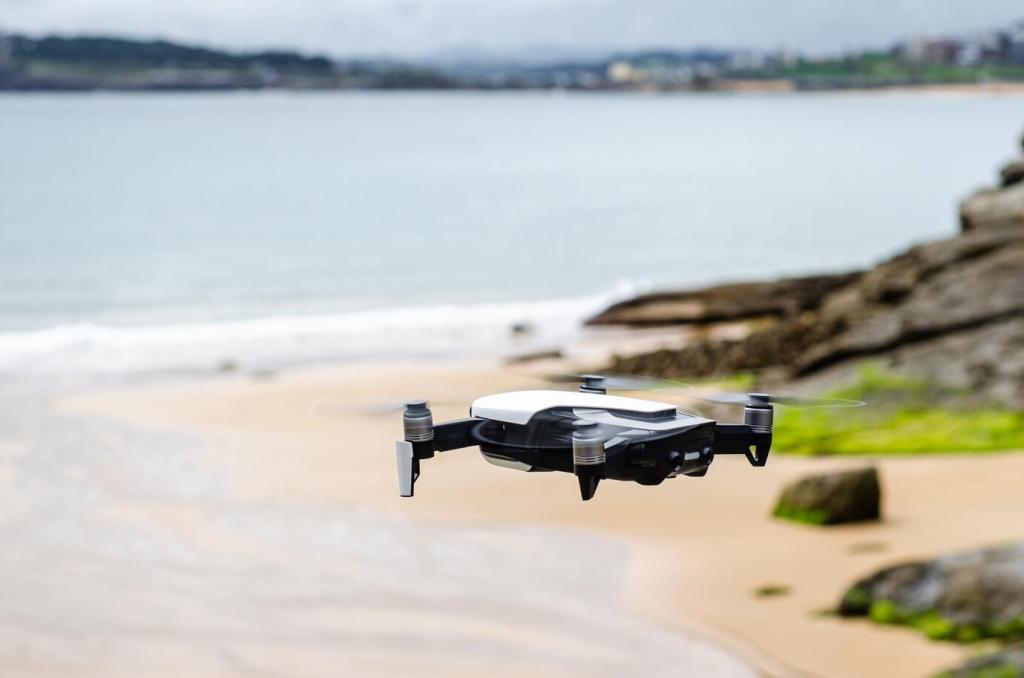

Exploring Advanced Drone AI Systems

Chosen theme: Advanced Drone AI Systems. Welcome! Today we dive into how intelligent aerial robots perceive their world, make split-second decisions, and learn from every mission. If you’re curious about the brains behind modern flight, subscribe and join our growing community.

What Makes a Drone ‘Intelligent’?

Advanced Drone AI Systems convert raw pixels, depth points, and inertial signals into meaningful situational awareness, then plan safe, efficient actions. Think of it as a rapid pipeline: perceive, predict, plan, and control—looping dozens of times per second while juggling wind, noise, and uncertainty.

What Makes a Drone ‘Intelligent’?

Drones improve with data: supervised models classify obstacles, self-supervised methods learn depth from motion, and reinforcement learning tunes maneuvers. Each flight refines policies and maps. Share your own logs or training tips in the comments, and let’s troubleshoot tricky datasets together.

Perception and Sensor Fusion in the Air

Seeing Through Glare, Fog, and Night

Advanced Drone AI Systems blend visible, thermal, and depth cues to cut through glare and poor lighting. When the sun washes a frame, thermal highlights heat sources; when fog obscures edges, IMU-aided stabilization and temporal filtering recover structure. Share your low-light tricks with readers.

Building a Reliable World Model

SLAM and neural depth estimators construct consistent maps as the drone zips along. Robustness comes from cross-checking modalities and maintaining uncertainty estimates. Tell us which mapping libraries you trust most and why—your experiences help newcomers avoid dead ends.

Try It: Your First Fusion Experiment

Record synchronized camera and IMU streams, then align them with a simple Kalman filter pipeline. Compare single-sensor versus fused trajectories. Post results, graphs, and lessons learned; we’ll highlight insightful experiments in upcoming posts and refine the template together.

Autonomous Navigation and Swarm Coordination

Model predictive control and sampling-based planners weigh risk, dynamics, and energy. The best Advanced Drone AI Systems revise paths mid-flight when wind shifts or a kite drifts into view. Comment with your favorite planner and why it shines in real, gusty air.

Autonomous Navigation and Swarm Coordination

Flocking rules echo starlings, while task allocation borrows from ant colonies. Communication-efficient strategies keep groups resilient even with dropped packets. Share a swarm story—what went wrong, what surprised you—and inspire others to iterate smarter on multi-drone missions.

Autonomous Navigation and Swarm Coordination

Sketch a mission: bridge inspection, crop scouting, or coastline mapping. What constraints matter most—battery, bandwidth, or airspace? Post your scenario and we’ll propose navigation tactics, coordination rules, and failovers tailored to Advanced Drone AI Systems facing your exact environment.

Edge AI, Compute Budgets, and Battery Reality

Quantization, pruning, and distillation shrink models without gutting accuracy. When Advanced Drone AI Systems run on NPUs or modest GPUs, milliseconds and milliwatts matter. Share your compression wins or regrets, and help peers balance speed, size, and precision for flight-critical tasks.

Edge AI, Compute Budgets, and Battery Reality

Compute adds heat, which adds weight for cooling, which affects flight time. Prop noise can mask acoustic sensors. Tell us how you route airflow, mount boards, or tune props to keep frames cool and quiet while maintaining stable inference rates aloft.

Safety, Ethics, and Evolving Regulations

Robust Advanced Drone AI Systems expect faults: GPS dropout, sensor drift, or compute hiccups. Layered checks, geofencing, and controlled landings protect people and property. Share your redundancy strategies—manual takeover thresholds, watchdog timers, or conservative fallback trajectories.

Safety, Ethics, and Evolving Regulations

Ethical drones minimize bystander filming, prefer edge processing to reduce data exposure, and label datasets responsibly. Tell us how you anonymize imagery, obtain consent, and set no-fly zones near sensitive sites. Your practices can guide a safer, kinder industry standard.

A Night Search Over the River

A volunteer team launched a thermal-equipped quad when fog rolled in. The AI filtered reflections and flagged a warm silhouette near reeds. Minutes later, rescuers reached an exhausted kayaker. Share your search-and-rescue insights, from model thresholds to humane communication with families.

Turtles, Drones, and Data Ladders

A coastal biologist used lightweight detectors to spot nesting turtles without shining bright lights. Edge classification preserved privacy and cut bandwidth. Post your conservation missions—what sensors worked, where models stumbled—and help protect habitats with thoughtful aerial intelligence.
Beckykluth
Privacy Overview

This website uses cookies so that we can provide you with the best user experience possible. Cookie information is stored in your browser and performs functions such as recognising you when you return to our website and helping our team to understand which sections of the website you find most interesting and useful.